Against Frictionless AI - Productive Middel
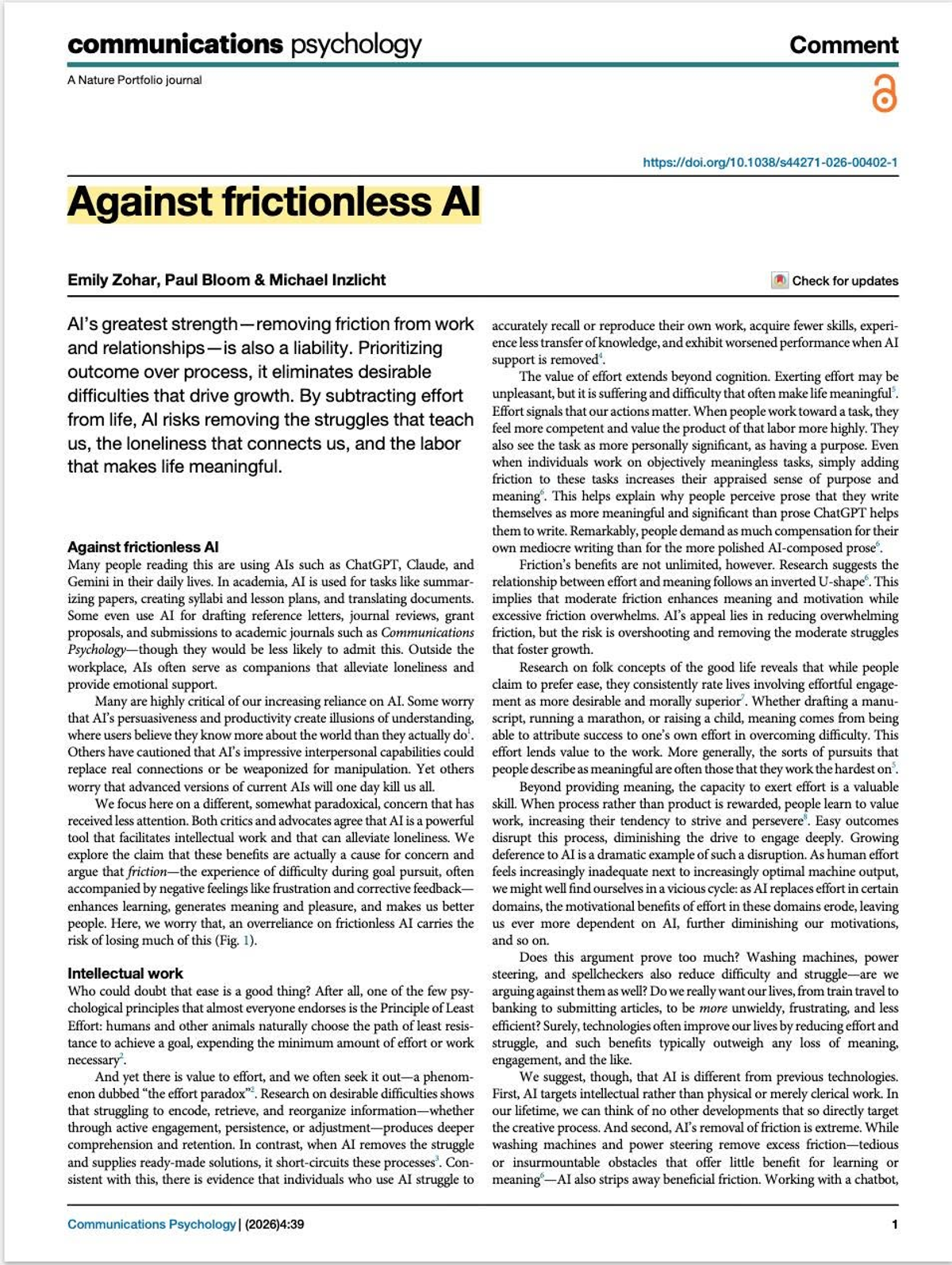
Every AI tool promises the same thing: less effort. Three researchers just argued that's exactly the problem.In a new paper published in Communications Psychology, Emily Zohar, Paul Bloom, and Michael Inzlicht make a case against frictionless AI. Their argument is simple. Friction, the difficulty and frustration of doing hard things, is what teaches us, gives our work meaning, and makes us better. Remove it wholesale and we lose plenty we never meant to.I've watched this in classrooms. A student breezes through an AI-assisted task, produces clean work, and blanks on the same concept a week later. The product was good but the learning didn't happen.Zohar et al. point to research on desirable difficulties: the struggle to work through information is what builds real understanding. Hand over the finished answer and that never happens. They cite evidence that heavy AI users recall their own work less accurately and perform worse once the AI is gone.The part teachers need is the shape of the curve. Friction and benefit follow an inverted U. A little struggle helps. Too much overwhelms. The goal was never maximum difficulty. It's the productive middle, the thing we've been calling productive struggle for years.The real job is to design effort back into learning, at the points where it does the most good. Let students brainstorm with AI, then defend what they kept. Solve first, check with AI second, never the reverse.The friction we remove for a student is friction they never learn to handle.
#AIinEducation #AILiteracy #ProductiveStruggle #EdTech #GenAI #TeachingWithAI #AIandLearning
ReferencesZohar, E., Bloom, P., & Inzlicht, M. (2026). Against frictionless AI. Communications Psychology, 4, 39.